
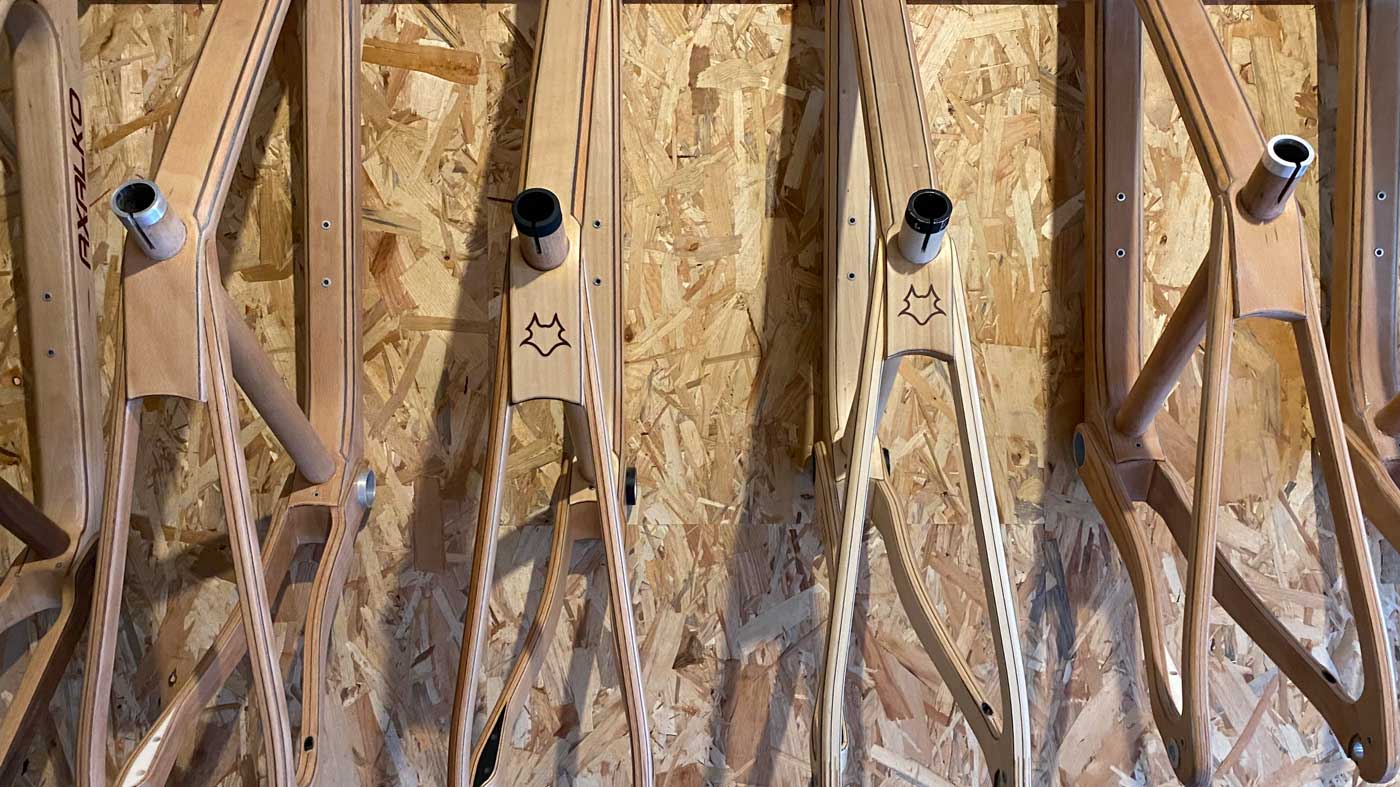
As often happens in our homeland, Axalko and Advanced BioComposites technology began with a challenge.
We inherit a culture shaped by our land, the sea and a rugged landscape. Basque is one of the world's oldest languages, and a passion for innovation, technology and discovery inspired our ancestors to achieve feats such as the first circumnavigation of the Earth.
Cycling is also deeply rooted in our culture, which has produced leading riders and bicycle brands.
When someone questioned whether nature could compete with technology, an idea began to take shape.
How can natural raw materials be processed to make the most of their properties in a bicycle frame? That question drove the development of our biomaterial technology.
Combining technical knowledge with a love of cycling, we began shaping the project in a garage workshop in a small town in Gipuzkoa.
Since 2009, we have researched and carried out countless tests on the behaviour of natural fibres.
From 2009 to 2011, we worked on our first frame prototypes, achieving approval for our first bicycle in 2011.
Between 2011 and 2016, we brought our first bicycles to market while improving key aspects of the product.
In 2017, we decided it was time to grow. We left the ground floor of our farmhouse and built new production facilities among the trees.
The circumstances of 2020 kept us indoors and gave us more time to develop our technology.
In 2021, we again did what had seemed impossible, developing our first CAE computer simulations of biomaterials and setting up strength-testing facilities.
We continue to develop our frame construction, combining wood, plant fibres and the connection elements required by bicycle components.
We continue developing products related to cycling, sustainable development and the circular economy, aiming to improve our bicycles and bring our technology to other sectors.
Axalko began making wooden and biomaterial bicycles in 2009, combining technical knowledge with a passion for cycling to create high-end frames.
Axalko has researched and tested natural fibres since 2009. Its first bicycle was approved in 2011, and products have continued to improve, showing that biomaterials can compete with conventional synthetic technologies.
The frame construction dissipates vibrations from the terrain. Think of the feel of a hammer with a wooden or fibre handle: the material changes how vibration reaches your hand.
Durability depends on construction, use and maintenance. Confirm that the build suits your routes and follow the instructions supplied with your frame.
Maintenance is similar to that of conventional bicycles. Special treatments, sealants and coatings protect the wood from moisture and weather changes, supporting durability and water resistance.
Axalko offers gravel, road and urban/fixed-gear bicycles. Ask about each frame version’s suitability, availability and components for your riding.
Axalko has developed CAE computer simulations for biomaterials and strength-testing facilities to ensure that each bicycle meets certification requirements.
Yes. Axalko offers personalisation for individual preferences and needs. Each bicycle is carefully handcrafted by skilled craftspeople.
Axalko uses wood and natural fibres, which are renewable materials. Its craft-based manufacturing process also minimises the carbon footprint.
Frames carry a 10-year warranty, subject to correct use, maintenance instructions and the applicable terms.